
How To Free Your Wild Beauty
Recently, a friend asked me, “What does it mean to be wild?” I’ve been sitting with that question.
For me, wildness is the experience of being fully expressed, of knowing who we are and who we are not, and of feeling supported, encouraged, and even celebrated in that expression. So often, our families and cultures shape unspoken rules about love and belonging. We learn, sometimes without realizing it, which parts of ourselves are welcome and which parts create too much difficulty for the people around us.
Wildness, as I’m experiencing it, is about reclaiming our own rules about who we are and allowing our energy to move more freely as we express that truth in the world.
Moving toward our wild beauty doesn’t feel selfish. If anything, it feels like the opposite. When we are connected to that kind of aliveness, we become more able to access and share the gifts we are here to offer. We participate more fully in the world rather than withdrawing from it. Our aliveness becomes part of our contribution, and our expression becomes one way of participating in collective care.
There is an idea in Chi for Two® that I have been carrying with me as I think about freeing the wild, embodiment, creativity, relationship, and the questions that arise in midlife: Divine Inspiration.
In the Chi for Two® framework developed by Dee Wagner, Divine Inspiration refers to the deep and luminous part of each person’s psyche—the unique light that each of us has to bring into the world. Chi for Two® describes four emanations of embodiment through which that inner spark finds expression: Navel Radiation, Contralateral Movement, Gesture, and Handling.
I love the idea that inspiration is something that lives within us and wants to move outward. It might become art, a new direction in our work, a relationship, a boundary, a song, a business, a garden, or simply a different way of inhabiting our lives. Yet having an impulse toward something and having the freedom to express that impulse are not the same thing.
From the beginning of life, we learn through relationships which kinds of movement are welcomed and which create difficulty. We reach and discover whether someone reaches back. We push and discover whether there is room for our resistance. We move away and discover whether connection remains. We learn whether our sounds are welcomed, whether our curiosity is encouraged, whether our bodies are given room, and whether our emerging selves can remain connected while becoming more fully ourselves.
Through these experiences, our bodies learn how to move toward, move away, take up space, receive, resist, protect, express, and remain connected.
Nobody gets exactly what they need from their parents. Even loving parents have their own histories, limitations, nervous systems, and wounds. We inevitably encounter moments when our emerging selves are not fully met, and we adapt. We become fluent in some ways of being and less fluent in others.
Over time, these adaptations can shape the possibilities we imagine for our lives. We may become very good at accommodating while having difficulty resisting. We may know how to care for others but not how to receive. We may know how to stay connected but not how to remain ourselves within connection. We may become skilled at containing our energy while losing touch with what it feels like to let that energy move.
Freeing your wild beauty involves creating more room for the parts of yourself that have not had enough freedom to move, express, create, and participate in relationships.
Creating new movement through relationship
We don’t have to discover these new possibilities alone.
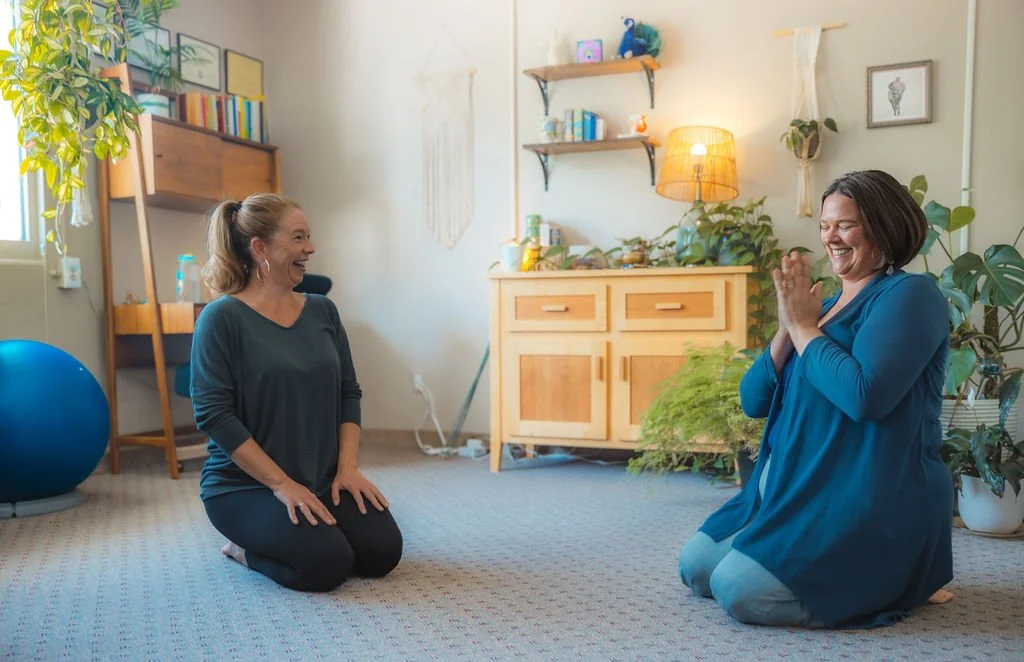
Within the coaching relationship, Chi for Two® offers the possibility of what we might call therapeutic redos—experiences in relationship that allow us to explore a movement pattern differently from the way we may have learned it originally.
If I learned early that reaching toward someone would be met with rejection, I may have stopped reaching. If resistance was met with disconnection, I may have learned to accommodate. If taking up space caused someone else to become uncomfortable, I may have learned to become smaller. These adaptations can become so familiar that they no longer feel like adaptations. They simply feel like who we are.
A therapeutic redo creates an opportunity for something different.
Within a relationship that is intentional, attuned, and supportive, we can begin to explore what happens when we reach and someone remains present. We can discover what it feels like to resist without losing connection. We can practice moving away and experiencing the possibility that relationships can remain intact. We can experiment with taking up space, receiving, expressing a preference, knowing our no, setting boundaries, changing our minds, or allowing our energy to become more visible.
The value of the redo is that it gives the body a new experience to learn from.
Learning the dance between us
Over time, repeated experiences of supported movement can expand our repertoire. We begin to have more than one way to respond. What once felt impossible may become imaginable. What was imaginable may become accessible. And what becomes accessible can eventually become part of the way we move through the world.
For me, there is something deeply hopeful about that.
Our patterns are not simply stories we have told ourselves. They are embodied ways of moving through relationship that developed for reasons. And because they developed through relationship, new relational experiences can offer pathways toward new movement.
Wild Beauty Inquiry
Take a few quiet moments with the questions below. You don’t need to find an answer immediately. Instead, notice what happens in your body as you consider each one.
What part of yourself has been asking for more room to move, express, create, or be seen?
Where in your life do you notice yourself automatically accommodating, containing, withdrawing, or making yourself smaller?
What movement feels easy and familiar to you in relationships? What movement feels more difficult?
Where do you long to reach toward something, and where do you long to move away?
What would it feel like to imagine expressing a need, desire, boundary, or creative impulse while remaining connected to someone you love?
What new movement might become possible if you had the experience of being fully yourself and still being met?
And finally:
What is the wild beauty within you that is waiting for more freedom to move?